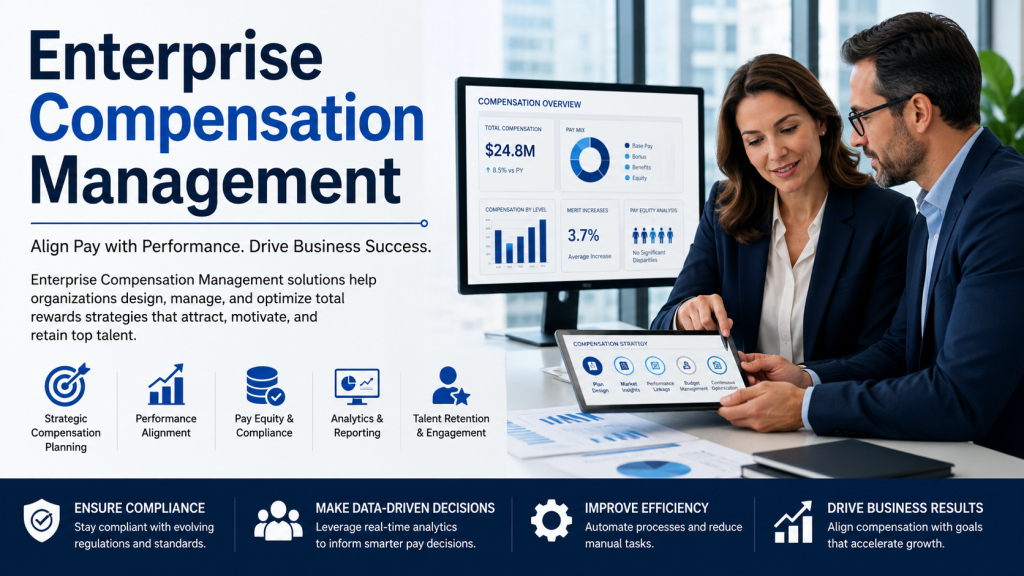
Beyond the Paycheck: How Enterprise Compensation Management is Rewiring the Fortune 500
In the modern enterprise, data is the new oil, but compensation is the new engine.
For decades, “payroll” was a back-office function. “Annual raises” were a dreaded spreadsheet ritual. But in the race for top-tier talent, the Fortune 500 has realized a hard truth: You cannot retain a data scientist with a manual spreadsheet, nor can you motivate a Gen Z manager with a once-a-year cost-of-living adjustment.
Enter Enterprise Compensation Management (ECM) . This is not just software for cutting checks. It is a strategic intelligence layer that connects business outcomes directly to employee wallets.
If your organization is still using siloed HRIS modules or—gasp—Excel to manage executive pay, global equity, and sales commissions, you are not just inefficient. You are invisible to your own workforce.
Here is a unique look at why ECM has become the most critical HR battleground of the 2020s.
The “Spreadsheet Apocalypse” of Legacy Enterprise Compensation Management
Before we praise the solution, let us acknowledge the villain: The legacy compensation process is broken.
Picture a global retail chain with 15,000 employees. Finance uses one system for bonuses. HR uses a different module for base pay. Department heads use personal spreadsheets for merit increases. By the time enterprise compensation management reconciles the data, the fiscal quarter is over, and three high-performing regional managers have quit because they felt undervalued.
This is the Spreadsheet Apocalypse. The hidden costs of failing to implement proper enterprise compensation management are staggering:
- Equity fatigue: Women and minorities are statistically underpaid when data is decentralized.
- Budget bleed: Without real-time visibility, departments overspend on hiring while under-investing in retention.
- Compliance chaos: Pay transparency laws in the EU and US now require absolute audit trails—something a
.xlsxfile cannot legally provide.
Modern enterprise compensation management solves this by creating a single source of truth. It unifies base pay, variable pay (bonus/commission), equity, and benefits into a governed, real-time platform.
The Three Pillars of Effective Enterprise Compensation Management
To be unique, an ECM strategy must move beyond automation. It must embrace three pillars: pay equity engineering, predictive workforce modeling, and total rewards transparency.
1. Pay Equity Engineering Through Enterprise Compensation Management
Most companies do “pay equity audits” once a year—after the damage is done. Advanced enterprise compensation management uses algorithmic auditing in real-time. As a manager types a proposed raise for a female engineer, the ECM engine flags if that proposed salary deviates from the market median for her male peers with the same tenure.
Unique angle: ECM shifts from reactive pay equity compliance to proactive pay justice. It doesn’t just find gaps; it suggests closing amounts before an offer letter goes out.
2. Predictive Compensation Planning for Uncertain Markets
In a volatile economy, static budgets are useless. Enterprise compensation management allows CFOs and CHROs to run “what-if” scenarios instantly:
- What if we raise the commission rate by 2% for the sales team but lower base pay by 1%? Who wins? Who quits?
- What if inflation hits 4%? How do we adjust merit curves without blowing the total budget?
Legacy systems take three weeks to answer these compensation planning questions. A dedicated enterprise compensation management platform does it in three seconds. This agility allows enterprises to pivot compensation planning strategies mid-cycle—a necessity in 2024’s unpredictable market.
3. Total Rewards Transparency and Employee Experience
Here is the most overlooked feature of enterprise compensation management: Visibility.
Did you know that 42% of employees cannot accurately value their total compensation package? They see a base salary and ignore the $15k in 401(k) matching, tuition reimbursement, and wellness stipends.
The best enterprise compensation management platforms include a “Total Rewards Statement”—a personalized, visual dashboard for every employee. When a worker sees that their actual total compensation is 25% higher than their base salary, retention rates spike. ECM transforms compensation from a transaction into a relationship.
Why Generalist HRIS Systems Fail at Enterprise Compensation Management
This is a crucial SEO distinction. Many vendors market “Compensation modules” inside their broader HRIS (like Workday, BambooHR, or Rippling). These are fine for small businesses.
But for the enterprise (1,000+ employees), niche enterprise compensation management platforms offer depth that generalists cannot match:
- Global compliance: Handling statutory bonuses in Mexico, 13th-month pay in the Philippines, and IR35 rules in the UK simultaneously.
- Complex variable pay: Marketing leaders don’t earn the same way as software sales. ECM handles stacked commissions, clawbacks, and multi-currency payouts.
- Integration architecture: True enterprise compensation management sits between HR, Finance, and Operations. A generalist HRIS can’t speak the language of ERP (Enterprise Resource Planning) systems like SAP or Oracle as fluently as a dedicated ECM tool.
The ROI of Implementing Enterprise Compensation Management
Switching to a dedicated enterprise compensation management platform carries a tangible ROI. Let’s do the math for a 5,000-person enterprise:
- Retention ROI: Reducing regrettable turnover by just 2% saves roughly $3 million in recruiting and training costs.
- Manager efficiency ROI: HR leaders currently spend 40% of their time on enterprise compensation management math. ECM reduces that to 10%, returning thousands of hours to strategic work.
- Overpayment detection ROI: ECM catches “salary creep”—the phenomenon where tenured employees fall outside competitive ranges. One manufacturing client saved $1.2 million in the first year by correcting overpaid legacy roles and reallocating funds to underpaid high-performers.
The Future: Continuous Enterprise Compensation Management
The last unique insight is this: Annual compensation cycles are dead.
The workforce now expects continuous enterprise compensation management. Just as we have continuous performance management (weekly check-ins), we need continuous pay adjustments. ECM platforms are evolving to support “spot bonuses,” on-demand pay, and quarterly market adjustments rather than annual reviews.
In the next five years, companies that do enterprise compensation management once a year will die by attrition. Their best people will leave for agile competitors who reward value in real-time.
Conclusion: Pay as a Strategy Through Enterprise Compensation Management
Enterprise compensation management is not a software category. It is a philosophical shift. It signals that your organization views employees as appreciating assets, not depreciating costs.
If you are a CHRO or CFO still wrestling with a Q4 spreadsheet frenzy, you have already lost the first quarter of next year. The market is moving too fast for manual processes. The compliance risk is too high for guesswork.
To win the war for talent, stop writing checks. Start engineering wealth, fairness, and transparency. That is the unique promise of modern enterprise compensation management.
Author’s Note: Looking for ECM solutions? Evaluate vendors based on their ability to handle your unique variable pay structures, not just their UI. A pretty dashboard cannot fix a broken pay philosophy. The right enterprise compensation management platform bridges strategy, data, and human motivation.
For more informative articles go on our site Glidedev.com
For more information you can go on U.S. Department of Labor pay equity case.